We keep reading and hearing about conflicting research and fantastic remedy cures. This needs a healthy dose of skepticism. At the very least we need to keep in mind that relationships between food/herbs and health/disease are not linear( see below). For example, the in vogue “magic” spice Turmeric in sensible amounts may be great thing, but in excess it can be a poison as well. How much more you need depends on how much do you consume currently as well as your physiological constitution.
Continue reading Let’s maintain healthy skepticism about nutrition researchGlobal Vitamin D deficiency amidst a shining sun, fortified food….and Roundup?
Isn’t it strange that there is a global deficiency of Vitamin D? Even if your doctors tested it and found the levels too low, they simply suggest a supplement. Have we ever bothered to find out why? Is there something deeper, a macro factor, lurking in our food supply?
Continue reading Global Vitamin D deficiency amidst a shining sun, fortified food….and Roundup?Medicine Nobel for “molecular mechanisms controlling circadian rhythms” . Didn’t Ayurveda already mention it a few thousand years ago?
Ayurveda and “Circadian Rhythm And Well-being
“This 2017 Nobel Prize winning research work is based on the circadian rhythm, which refers to biochemical oscillators that respond to solar cycles. Laureates Jeffrey Hall and Michael Rosbash discovered that PER, the protein encoded by period, accumulated during the night and was degraded during the day. Thus, PER protein levels oscillate over a 24-hour cycle, in synchrony with the circadian rhythm.
It is striking to note how Ayurveda establishes the link between the revolution-rotation of the earth and human health. According to Ayurveda, the different tridoshas (the three humors: Vata, Pitta and Kapha, in the body that need to be balanced for perfect health), are predominant during different times of the day. For instance, Pitta Dosha which controls digestion, metabolism and energy production is high between 10am and 2pm. Pitta ensures the availability of energy to perform various activities. This very well correlates with the high alertness, best co-ordination and fastest reaction times shown in the illustration below. Research works on circadian rhythm from the perspective of Ayurveda correlate the time of the day and hormonal activity, very similar to the degeneration of protein with the day as discovered by the laureates. For example, Kapha dosha is predominant in early phase of the day. Most of the hormones are at the peak level in the morning and they decline with the time and are lowest at the evening time.”
From Nobel Prize summary:
“Keeping time on our human physiology
The biological clock is involved in many aspects of our complex physiology. We now know that all multicellular organisms, including humans, utilize a similar mechanism to control circadian rhythms. A large proportion of our genes are regulated by the biological clock and, consequently, a carefully calibrated circadian rhythm adapts our physiology to the different phases of the day (below). Since the seminal discoveries by the three laureates, circadian biology has developed into a vast and highly dynamic research field, with implications for our health and wellbeing.
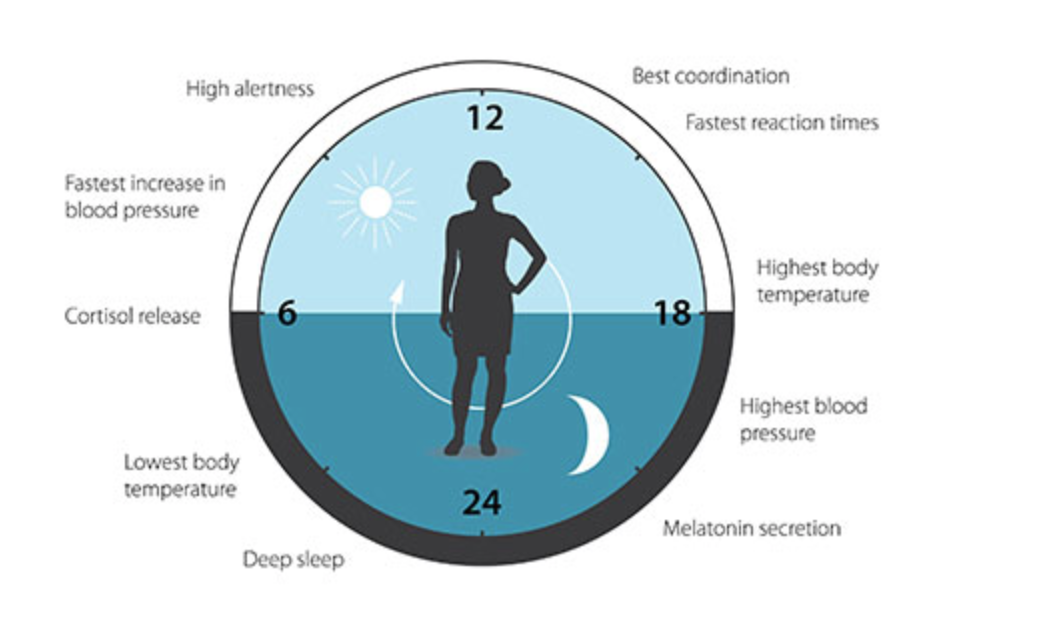
The circadian clock anticipates and adapts our physiology to the different phases of the day. Our biological clock helps to regulate sleep patterns, feeding behavior, hormone release, blood pressure, and body temperature.”
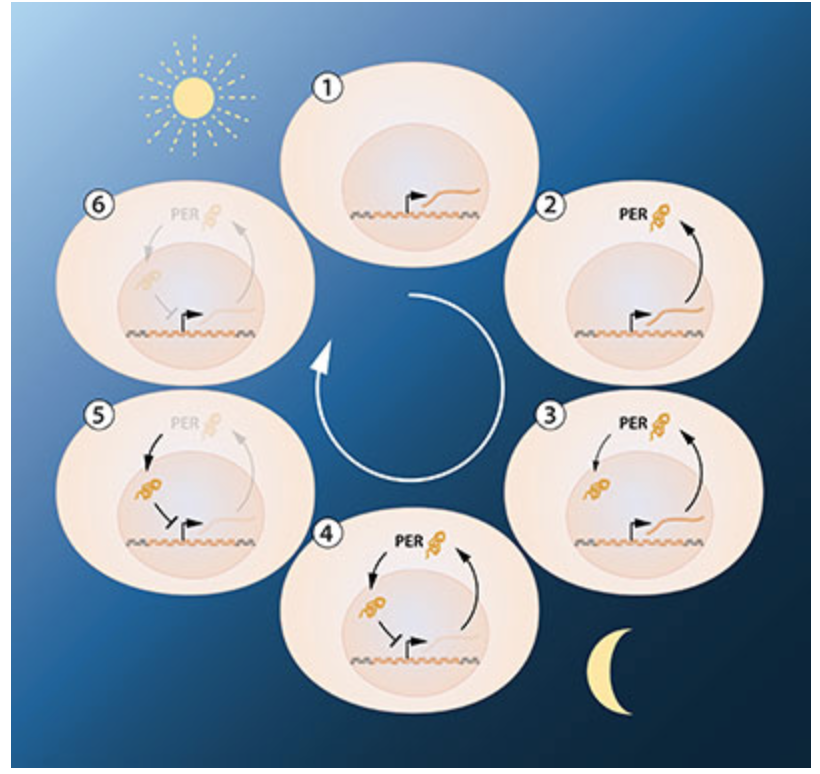
A simplified illustration of the feedback regulation of the periodgene. The figure shows the sequence of events during a 24h oscillation. When the period gene is active, period mRNA is made. The mRNA is transported to the cell’s cytoplasm and serves as template for the production of PER protein. The PER protein accumulates in the cell’s nucleus, where the period gene activity is blocked. This gives rise to the inhibitory feedback mechanism that underlies a circadian rhythm.”
Source: Swarajyamag.com; Nobelprize.org
DISCLAIMER
Use of Nada, the sound of silence in meditation
(Listen to the sound of what appears to be a didgeridoo at 39.40 into the discussion.)
The Shankhmukhi mudra is often used as a part of the series of steps in achieving a meditative state. Have you ever wondered how this sound “sounds”? Try to listen to your own anahata sounds and decide whether it is your simple affliction with tinnitus of something more and deeper than that!
The Yoga Upanishad (36-38) says ” that when the Nada sound has reached the middle of the head it sounds like a mountain-cataract”. So maybe you hear something akin to this?
I found an interesting piece by Kimba Arem on this topic:
She writes:
“The Nāda yoga system divides music into two categories: internal music, anahata, and external music,ahata. While the external music is conveyed to consciousness via sensory organs in the form of the ears, in which mechanical energy is converted to electrochemical energy and then transformed in the brain to sensations of sound, it is the anahata chakra, which is considered responsible for the reception of the internal music, but not in the way of a normal sensory organ.
The anahata concept refers to one’s own personal sound vibrations, which is thought to be so closely associated with one’s self and the self that a person can not share their anahata with another human being. In other words, this inner sound is sacred and once reached will open the practitioner’s chakras, which ultimately will unite the body to the divine/cosmos.
With continued sounds, a focused mind and controlled breath, the individual can, according to Nāda yoga, “listen in on” their own anahata, their own “inner sound”, which can take up to nine different forms. Such a process of inner awareness and sensitivity leads to increased self-recollectedness and finally to awakening.
To concentrate on this inner sound as a support for meditation is very helpful to tame the mind, and when it has been clearly recognized, used for self-recollectedness in outer life as well. Eventually, it can be experienced as penetrating all matter and indeed vibrates eternally throughout the Creation.”
This is what the classic Sanskrit treatise Hatha Yoga Pradipika has to say on the subject Chapter IV( verses 83-87):
“The sound which a muni hears by closing his ears with his fingers, should be heard attentively, till the mind becomes steady in it.81.
अभ्यस्यमानो नादो|अयं बाह्यमावॄणुते धवनिम |
पक्ष्हाद्विक्ष्हेपमखिलं जित्वा योगी सुखी भवेत || ८३ ||
abhyasyamāno nādo|ayaṃ bāhyamāvṝṇute dhvanim |
pakṣhādvikṣhepamakhilaṃ jitvā yoghī sukhī bhavet || 83 ||
By practising with this nâda, all other external sounds are stopped. The Yogî becomes happy by overcoming all distractions within 15 days.82.
शरूयते परथमाभ्यासे नादो नाना-विधो महान |
ततो|अभ्यासे वर्धमाने शरूयते सूक्ष्ह्म-सूक्ष्ह्मकः || ८४ ||
śrūyate prathamābhyāse nādo nānā-vidho mahān |
tato|abhyāse vardhamāne śrūyate sūkṣhma-sūkṣhmakaḥ || 84 ||
In the beginning, the sounds heard are of great variety and very loud; but, as the practice increases, they become more and more subtle.83.
आदौ जलधि-जीमूत-भेरी-झर्झर-सम्भवाः |
मध्ये मर्दल-शङ्खोत्था घण्टा-काहलजास्तथा || ८५ ||
ādau jaladhi-jīmūta-bherī-jharjhara-sambhavāḥ |
madhye mardala-śangkhotthā ghaṇṭā-kāhalajāstathā || 85 ||
In the first stage, the sounds are surging, thundering like the beating of kettle drums and jingling ones. In the intermediate stage, they are like those produced by conch, Mridanga, bells, &c.84.
अन्ते तु किङ्किणी-वंश-वीणा-भरमर-निःस्वनाः |
इति नानाविधा नादाः शरूयन्ते देह-मध्यगाः || ८६ ||
ante tu kingkiṇī-vaṃśa-vīṇā-bhramara-niḥsvanāḥ |
iti nānāvidhā nādāḥ śrūyante deha-madhyaghāḥ || 86 ||
In the last stage, the sounds resemble those from tinklets, flute, Vîṇâ, bee, &c. These various kinds of sounds are heard as being produced in the body.85.
महति शरूयमाणे|अपि मेघ-भेर्य-आदिके धवनौ |
तत्र सूक्ष्ह्मात्सूक्ष्ह्मतरं नादमेव परामॄशेत || ८७ ||
mahati śrūyamāṇe|api megha-bhery-ādike dhvanau |
tatra sūkṣhmātsūkṣhmataraṃ nādameva parāmṝśet || 87 ||
Though hearing loud sounds like those of thunder, kettle drums, etc., one should practise with the subtle sounds also.86.
घनमुत्सॄज्य वा सूक्ष्ह्मे सूक्ष्ह्ममुत्सॄज्य वा घने |
रममाणमपि कष्हिप्तं मनो नान्यत्र छालयेत || ८८ ||
ghanamutsṝjya vā sūkṣhme sūkṣhmamutsṝjya vā ghane |
ramamāṇamapi kṣhiptaṃ mano nānyatra chālayet || 88 ||
Leaving the loudest, taking up the subtle one, and leaving the subtle one, taking up the loudest, thus practising, the distracted mind does not wander elsewhere.87.”
 Ayurkula