We keep reading and hearing about conflicting research and fantastic remedy cures. This needs a healthy dose of skepticism. At the very least we need to keep in mind that relationships between food/herbs and health/disease are not linear( see below). For example, the in vogue “magic” spice Turmeric in sensible amounts may be great thing, but in excess it can be a poison as well. How much more you need depends on how much do you consume currently as well as your physiological constitution.
Continue reading Let’s maintain healthy skepticism about nutrition researchCategory Archives: Author: Rajat Bhu
Global Vitamin D deficiency amidst a shining sun, fortified food….and Roundup?
Isn’t it strange that there is a global deficiency of Vitamin D? Even if your doctors tested it and found the levels too low, they simply suggest a supplement. Have we ever bothered to find out why? Is there something deeper, a macro factor, lurking in our food supply?
Continue reading Global Vitamin D deficiency amidst a shining sun, fortified food….and Roundup?Medicine Nobel for “molecular mechanisms controlling circadian rhythms” . Didn’t Ayurveda already mention it a few thousand years ago?
Ayurveda and “Circadian Rhythm And Well-being
“This 2017 Nobel Prize winning research work is based on the circadian rhythm, which refers to biochemical oscillators that respond to solar cycles. Laureates Jeffrey Hall and Michael Rosbash discovered that PER, the protein encoded by period, accumulated during the night and was degraded during the day. Thus, PER protein levels oscillate over a 24-hour cycle, in synchrony with the circadian rhythm.
It is striking to note how Ayurveda establishes the link between the revolution-rotation of the earth and human health. According to Ayurveda, the different tridoshas (the three humors: Vata, Pitta and Kapha, in the body that need to be balanced for perfect health), are predominant during different times of the day. For instance, Pitta Dosha which controls digestion, metabolism and energy production is high between 10am and 2pm. Pitta ensures the availability of energy to perform various activities. This very well correlates with the high alertness, best co-ordination and fastest reaction times shown in the illustration below. Research works on circadian rhythm from the perspective of Ayurveda correlate the time of the day and hormonal activity, very similar to the degeneration of protein with the day as discovered by the laureates. For example, Kapha dosha is predominant in early phase of the day. Most of the hormones are at the peak level in the morning and they decline with the time and are lowest at the evening time.”
From Nobel Prize summary:
“Keeping time on our human physiology
The biological clock is involved in many aspects of our complex physiology. We now know that all multicellular organisms, including humans, utilize a similar mechanism to control circadian rhythms. A large proportion of our genes are regulated by the biological clock and, consequently, a carefully calibrated circadian rhythm adapts our physiology to the different phases of the day (below). Since the seminal discoveries by the three laureates, circadian biology has developed into a vast and highly dynamic research field, with implications for our health and wellbeing.
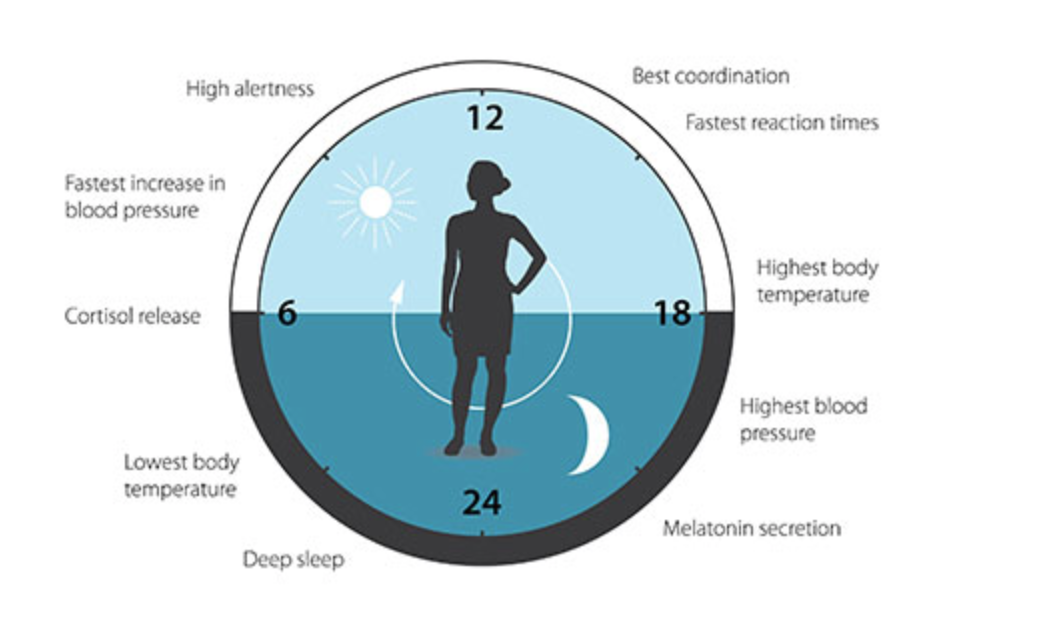
The circadian clock anticipates and adapts our physiology to the different phases of the day. Our biological clock helps to regulate sleep patterns, feeding behavior, hormone release, blood pressure, and body temperature.”
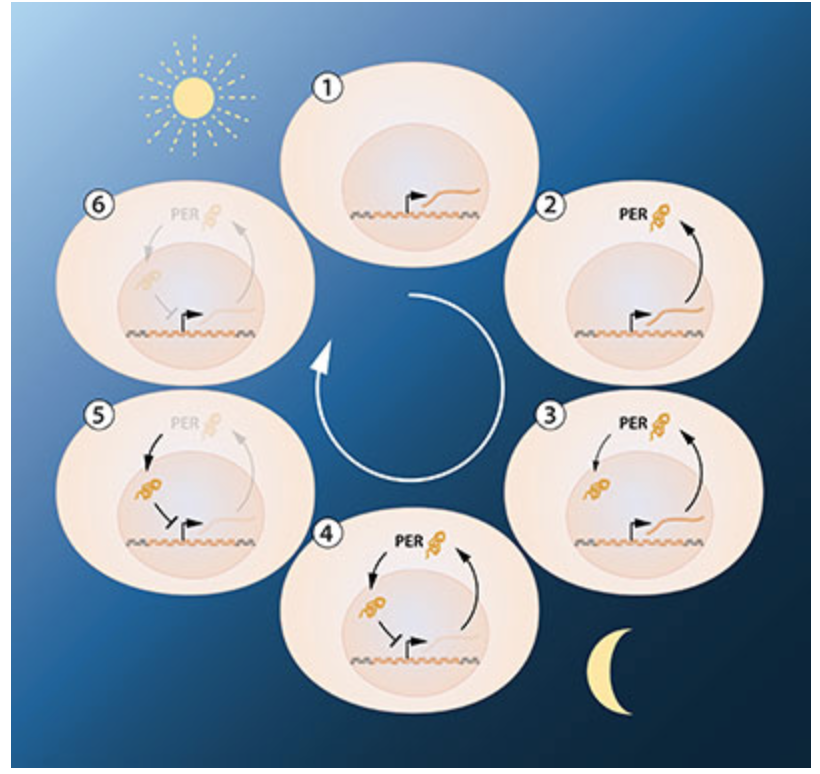
A simplified illustration of the feedback regulation of the periodgene. The figure shows the sequence of events during a 24h oscillation. When the period gene is active, period mRNA is made. The mRNA is transported to the cell’s cytoplasm and serves as template for the production of PER protein. The PER protein accumulates in the cell’s nucleus, where the period gene activity is blocked. This gives rise to the inhibitory feedback mechanism that underlies a circadian rhythm.”
Source: Swarajyamag.com; Nobelprize.org
DISCLAIMER
The challenge of proving causation
Although experimental “interventionist” studies ( as in placebo vs. experimental treatment) are generally considered the most powerful research design, “observational” study data (as in Ecological populations, Cross section studies, Case control studies and Cohort studies) is much easier to come by, often due to cost alone.
In the circumstances it becomes very important to distinguish between association and causation. Some observations on these topics:
1)”Because observational studies are not randomized, they cannot control for all of the other inevitable, often unmeasurable, exposures or factors that may actually be causing the results. Thus, any “link” between cause and effect in observational studies is speculative at best.”
2)”Readers of medical literature need to consider two types of validity, internal and external. Internal validity means that the study measured what it set out to; external validity is the ability to generalize from the study to the reader’s patients. With respect to internal validity, selection bias, information bias, and confounding are present to some degree in all observational research.
- Selection bias stems from an absence of comparability between groups being studied. Information bias results from incorrect determination of exposure, outcome, or both.
- The effect of information bias depends on its type. If information is gathered differently for one group than for another, bias results.
- By contrast, non-differential misclassification tends to obscure real differences.
- Confounding is a mixing or blurring of effects: a researcher attempts to relate an exposure to an outcome but actually measures the effect of a third factor (the confounding variable). Confounding can be controlled in several ways: restriction, matching, stratification, and more sophisticated multivariate techniques.
If a reader cannot explain away study results on the basis of selection, information, or confounding bias, then chance might be another explanation. Chance should be examined last, however, since these biases can account for highly significant, though bogus results. Differentiation between spurious, indirect, and causal associations can be difficult. Criteria such as temporal sequence, strength and consistency of an association, and evidence of a dose-response effect lend support to a causal link.“
Source 1: Healthnewsreview.org
Article: “Observational studies: Does the language fit the evidence? Association vs. causation”
Source2: NCBI.org
Article: “Bias and causal associations in observational research.”
 Ayurkula